Banadella
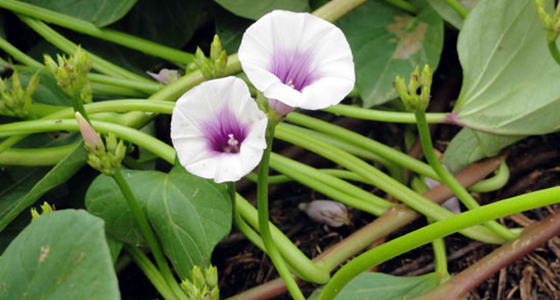
The first flowers of the Banadella or Passion Fruit vine opened in our garden today. This unusual varietal originates from South America. The beautiful pink flowers are succeeded by long, oval shaped fruit which turn yellow when ripe.
A pond for scented lilies
We have just finished the pond in the indigenous fragrance garden and are now eagerly waiting for new lily leaves and flowers to appear above the water. The new pond with its thick sandstone edge, is an inviting feature to linger at while enjoying the fragrance of the lilies, reflections in the water and shade of the surrounding African walnut trees (Schotia brachypetala), after a long walk through the garden.
The water is still murky, but it should settle and clear within the next few weeks, as the water in the pond is filtered naturally by plants. The pond depth of 600mm is ideal for water lilies to thrive. We planted, or rather plunged, pots with waterblommetjies and water lilies into a thick bed of stone chips.
Both these indigenous water lilies have fragrant flowers, but you need to get close with your nose almost touching the petals to catch the delicate scent. The winter flowering waterblommetjies (Aponogeton distachyos), reminds me of vanilla while the summer flowering blue water lily (Nymphaea caerulea) has a light citrus scent.
See more images of the process of creating our lily pond in our Gardens Album on Facebook, and we hope to see you at the pond soon too, enjoying the delicate blooms.
Groete,
Liesl.
Travel & Leisure, July 2011
In the Cape Winelands, a handfull of inns and restaurants are shaping the regions farm-to- table movement by digging deeper into the coutry’s past……
Artravel, Issue no.39
Dans le monde du design, de l’architecture et de la communication, la Design Indaba Conference est un must absolu!
Bottom of the barrel
Our assistant winemaker Alta had her raingear on yesterday. It wasn’t to deal with the wintery weather, though…
When wine has been lying in a tank for a while, the tartaric acid inside the wine tends to crystalize against the inside of the tank wall. There are a few different ways to get this off, but Alta got inside this big wooden tank with her high pressure gun, and she sprayed it off!
Winemaking sounds like such a glamorous profession, doesn’t it?
Sud Afrika magazine
A review of Babylonstoren in German in Süd Afrika magazine
Farm to table
In the July edition of Travel + Leisure magazine, journalist Douglas Rogers writes about his visit to Babylonstoren, waxing lyrical about our determinedly locally grown and sourced restaurant, calling it “the ultimate farm-to-table fantasy”:
I’m sitting in the sleek kitchen of my suite, a modern glass cube attached to a traditional thatched-roof, 18th-century landhuisie (cottage), and I’m gazing out on eight acres of organic wonder: scented beds of thyme, rosemary, and wild garlic; a berry block with Cape gooseberries and mulberries; a pergola walk dripping with table grapes; an orchard of naartjies, nectarines, and grapefruit watered by a restored sluice system; even an apiary for honey. And vegetables, too—butternut and beets; rocket and radishes; peppers of impossibly bright hue.
Best of all, it’s mine. In the ultimate farm-to-table fantasy, as a guest I get to walk its mazy paths, pick whatever herbs, fruits, and vegetables I fancy—there are some 300 edible varieties—and prepare them in my designer kitchen. And if I don’t fancy cooking? Well, I can just amble down the tractor-cut road outside my door to the farm’s restaurant, Babel.
Read the full article here, and then book your table at Babel restaurant to see for yourself.
The man in the cellar
It’s time to put names to the faces behind the seamless workings at Babylonstoren in a series of interviews with the team. Today, we meet Charl Coetzee, our winemaker and social media enthusiast.
Tell us a bit about your working enviroment at Babylonstoren.
I work in the cellar which is more or less an industrial type environment, with the benefit of being in the countryside, surrounded by tanks and barrels full of wine!
What does a typical day at Babylonstoren hold for you?
I usually start out with my assistant winemaker, Wian, drinking a cup of coffee, and planning for the day. Afterwards, I’m at my laptop for a while, answering emails, doing admin, and also managing our website and social media.
Every day there is physical work to do in the cellar, as well as a couple of meetings to attend. And then, of course, being a wine maker I have to taste my wine all the time, and once a month, the Babylonstoren staff join me at the cellar for an after work wine tasting.
What’s your favourite part of the day at work?
The morning coffee before the day starts!
If you could take an hour’s break somewhere at Babylonstoren, where would you go?
I think I’d either be on the deck of the wooden boathouse at the dam, or I’d go to the highest part of the farm in the south corner on our farm.
Tell us something about yourself that not many people know.
Well…if I tell you then people will know! But I guess I can reveal that I am really scared of thunder!
What makes you happy that you work at Babylonstoren? I feel very fortunate to be part of a really innovative and stimulating team of people. I also like the fact that working here really challenges you to think outside the box and gives you the opportunity to let the creative juices flow. I also get a lot of exposure to a lot of things that I have never been exposed to previously in my life!
What’s coming up next that you’re excited about?
Lots and lots of stuff! All our wines in the cellar, developing, and we’ve just started to look at different kinds of bottles, labels and other packaging. We are working on our future wine shop, where we will sell Simonsberg wines. We are working on the plans of our future distillery, and we’re eagerly awaiting our glasshouse to arrive from France. That’s just a few things happening around here, but really, working at Babylonstoren means there’s something to get excited about every new day!
Gardening series: Soetpatats
In the second of our series of gardening tips from Liesl, she tells us all about how her team got to the point of harvesting our crop of soetpatats this month.
We harvested sweet potatoes this month, as they’re making a wintertime special appearance on the menu at Babel.
The thin stemcuttings we planted in the heat of Summer did not look very impressive, but with regular watering, they quickly flourished into lush mounds of foliage. The lovely white & mauve flowers appeared late summer as the plants matured, hiding shyly underneath the leaves.

About a month before harvest, we cut the leaves to encourage the roots to mature. To discourage mice from feeding on the tubers, we covered the beds with a thick layer of mulch made from roughlyshredded vines – it worked well. The mice went hungry, and our soetpatats grew nicely!
After 5 months in the ground, we eventually lifted the plants with great expectation and care, making sure that the moist, thin skins on the tubers were not damaged, as this helps prevent them from rotting in storage.
We harvested 4 colours – white, purple, orange and yellow. The orange variety is the old fashion sweet potato known as borrie patat, while the white variety has an interesting long shape, and is more of a collector’s item for speciality chefs.

The tubers are now drying in the store for2 weeks, waiting for the roots to sweeten before we send them our restaurant, where the chef, Simone, will do her magic with this exceptionally nutritious vegetable. Next time you visit Babel for lunch, be sure to look for soetpatats on the menu!
The Garden
We often mention what we’re up to in the garden at Babylonstoren here, and on our Twitter feed too, and with good reason: it really is at the heart of the farm, supplying food for the restaurant, produce for our shop, and provides the most lovely setting for guests staying in the top notch Cape Winelands accommodation we have on offer.
Designed by renowned French garden designer, Patrice Taravella, the eight acre garden is formal in structure, with a huge variety of fruit, vegetables and herbs growing in formal beds, bordered by espaliered fruit trees and intersected by walkways. The concept was inspired by the Company’s Gardens of the Cape, where for centuries ships would replenish with sweet water, vegetables and fruit at the halfway station between Europe and Asia. The garden is divided into fifteen clusters spanning vegetable areas, berries, bees, indigenous plants, ducks and chickens and includes a prickly pear maze. Gravity feeds water into waterways from stream into the garden as it was done for 300 years.
The Babylonstoren garden lies behind the main house and borders the guest suites. Laid out according to a systematic grid, there are three axis points: The bell tower axis and historic cellar axis cut parallel through the garden east to west, while the Babylonstoren hill axis runs along the historic werf (homestead) axis parallel to the road historically connecting Cape Town to Franschhoek.
Serious gardeners may be interested to download a PDF of the garden layout, as well as a list of all the plants we cultivate. The gardens are open daily from Wednesday to Sunday, from 9:00 – 17:00, and you’re welcome book a garden tour by calling 021 863 3852, or via email. Do come and visit – we have so much to share.
Boere Witblits & Mampoer
Details
At Babylonstoren, we tend to think big, and part of this is paying attention to the smallest of details.
Spatula approves
Online foodie magazine Spatula visited Babylonstoren and had a really good time. After tasting the food, visiting the gardens, and taking some rather lovely photos too, this was their conclusion:
“We … highly recommend that you get your skates on and check it out too.”
Read the full article right here.
Gardening tips: Strawberries
In the first of what we hope will be a very useful series of tips and techniques from our master gardener, Liesl van der Walt , today is all about our experience with planting strawberries:
Timing
May is the month for planting strawberries in our garden, but I am told that any time from mid-March is good for “Selecta” the strawberry variety that is easy to grow in the Cape. We finished planting this week, just in time for the winter rains to settle them in nicely.
The area we selected for the strawberries is a long bed in full sun next to the berry block where the other berries – raspberries, blackberries, English gooseberries and red currents grow in semi-shade.
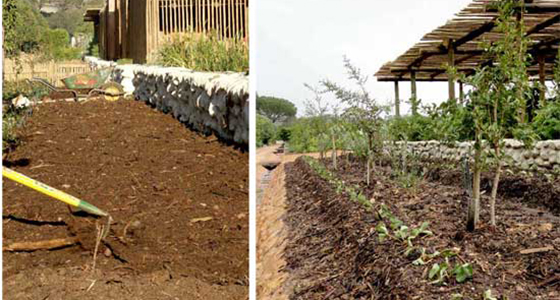
Preparing the ground: We prepared the ground by digging it over about a spade depth. We added plenty of our best, well-decomposed compost we made earlier the summer, to get a rich growing medium.
To ensure good drainage we raised the ground and made 2 low mounds about 15cm high and 30cm wide with a narrow footpath in the middle for easy access to each plant.
Selecting new plants and lifting runners: Last year’s plants multiplied by hundreds and thousands, spreading with tendrils that rooted where they touched the ground. We simply had to lift and divide. The mother plants with old dark roots were thrown out and only the young plantlets with vigorous, white roots kept.
As we lifted, the healthy young plants were cleaned by removing any old leaves and placed in a bucket of water to prevent them from drying out before planting.
Planting: The young plants were spaced 25cm apart and planted with their crowns at ground level. Each plant was pressed down firmly in the ground and watered well. Now in their first week we take extra
care with regular watering making sure the plants do not dry out.
Luckily the rain has arrived as predicted and I hope growing strawberries will be as easy as this until we start picking the first fruits in spring.
Happy planting,
Liesl