Blossoms for breakfast

Ons ontbyt is nou ekstra spesiaal vir bloeisel tyd! Geniet die suuring plaatkoekkie met gerookte forrel, vars boomspanspek & lemoen bloeisel met ‘triple sec’ konsentraat.


Geniet dit!

Simone.

Comment

For a good cause

When visitors come to Babylonstoren, whether it’s for lunch or a garden tour, they are sometimes surprised that an entrance fee of R10 per person is requested at the gate. On the ticket, it states that the money collected from this entrance fee all goes to the Babylonstoren Trust.

The Babylonstoren Trust raises funds for community projects, like the crèche where all the kids of our farm workers are cared for, while their parents are working.  The Trust also helps local school children with soccer and netball kit and transport to sports days.  So your R10 entrance fee is contributing to the upliftment of our community here at Babylonstoren, and we all thank you very much for this.

1 Comment

New winter menu

Winter has lots of good things to offer, and one of them is the exciting Winter menu at Babel restaurant, sporting delights along the lines of:

Sirloin on the bone or prime rib, marinated in fresh winter savoury and Frantoio olive oil, with a poached duck egg and celeriac, with horseradish remoulade.

Warm kale, cavallo nero and chunky parmesan broth, with a side salad of mange tout, Granny Smith apple, green kohlrabi, spekboom, green oak lef and frilly lettuce, with a drizzle of salt, preserved lemon, Cape sorrel and caraway.

White chocolate and savoy cabbage terrine

To see the rest of our winter offering at Babel, please download our menu right here.

Comment

Travel & Leisure, September 2011


Super Agents A List- With a wealth of expertise, these power brokers are the most infirmed and connected in the travel industry……           

 Read Full Article Here

Comment

The science of Kumquat jam

Whilst cooking jam with the delicious kumquats from our garden, I made an interesting find: Two equal sized batches of jam looked completely different in colour, and the only difference was that different pots were used.


The way it worked is that one pot had a large surface area, so more water could evaporate, and the other pot had a much smaller surface area. This meant that: the pot with a larger surface area reached the correct consistency much sooner, which meant a lighter colour jam (on right), while the pot with a smaller surface area cooked for much longer, so the jam was darker.

Both, of course, are equally delicious, and you’ll find these fruits of our garden (and semi-scientific experiments) in the Babylonstoren shop.

This is a really interesting journey, as we attempt to find the best ways to preserve our garden’s produce. Please share your own preserving experiences and helpful tips with us.

Groete van die kombuis af,
Annemarié Nortjé

Comment

Bye op die plaas

Die week se hoogtepunt is die bye wat uiteindelik gisteraand gebring is deur ons byekenner Voytek.  Twee tydelike korwe in die steenvrugte boord om te help met die bestuiwing van die pruime, appelkose, perskes en nektariens.  Vier korwe se bye is oorgeskuif na ons eie korwe in die bye area tussen die amandelbome.


This week’s highlight was the long-anticipated arrival of our, brought by our beekeper, Voytek. The beehives in the stonefruit orchard will help with fertilising our blossoming plums, apricots, peaches and nectarines, and we’ve also moved some bees into the almond orchard.

Comment

AFAR, September/October 2011

Fourteen miles from Franschhoek Village,Babylonstoren – once a gabled, whitewashed Cape Dutch homestead-is now a stunning Hotel and working guest farm.

       Read Full Article Here

Comment

Pruning trees

We started the winter prune of our formed apples, pears & quince trees today. After my 2 week visit to France, learning the traditional pruning methods at the Prieure D’ Orsan, I am ready to experiment on the trees at Babylonstoren.

The 2-3 years old trees in our garden already have their basic shape, and the challenge is to form fruit continuously along the main stem with the side branches as short as possible.  Starting with the fan shaped quince with five spreading arms and the simple U-shaped pears, we had to be brave and cut almost 2/3 of this year’s grow to encourage the development of eyes from the bottom to the top of the stems. With this method, it can take up to 10-15 years for the leader to complete the desired the form, compared to commercially trained trees where the leader gets to the top of the structure within 2-3 years.

Yours optimistically,

Liesl


Comment

All gardens, great & small

We’re well aware that our meticulously planned, 8 acre garden at Babylonstoren really is gardening on a particularly large scale, but that doesn’t mean we don’t appreciate small-scale – or even micro-scale – gardening. That’s why we love this garden-in-a-can idea from venerable Northern Italian floriculture company, Arnoldi Europe.

These MicroGiardini are packed with a growing compound, seeds or a bulb, and with the addition of water and light, a flowering plant or herb will grace your windowsill after just a month of care.  Gardening’s fun, whatever scale it’s at!

(via coolhunting)


Comment

Prieure Notre Dame D’ Orsan, Part IV

During July, our head gardener, Liesl van der Walt spent two weeks gardening at the Prieure Notre Dame D’ Orsan in France, home of the architect Patrice Taravella, who designed the gardens at Babylonstoren. In Part IV of her travel diary, Liesl tells us more about other gardens she visited in France:

After our first stop in the Loire, which was at the Castle of Talcy, where they have a collection of apples and pear trees beautifully trained in different forms, we followed the river to the castle at Chaumont. Here they have show-gardens by different international designers, where a guide explained how this year’s themes – Gardens of the Future, or the Art of Happy Biodiversity – was interpreted in each garden. I loved the fun mushroom-shaped compost receptacles (below).  The gardens were fun and inspiring, and the castle, with its grounds filled with giant trees had us enchanted until late evening.

I wish I’d had more than just a morning to spend in the potager at Chateau de Valmer. The way the fruit trees and vines were trained against walls and on structures throughout the garden enhanced the design by being beautiful and practical. It looked to me like a garden that is really loved and enjoyed by its gardeners.

View of Valmer

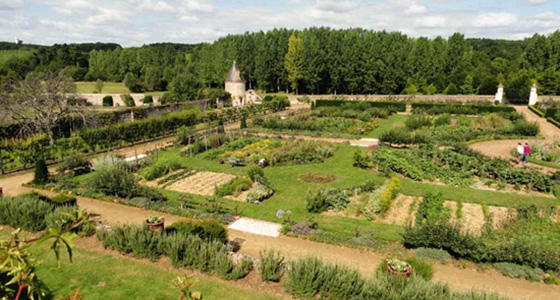
The very formal design of the gardens at Villandry, along with the thousands of visitors, was impressive, but it did not appeal to me immediately. The overview looked so controlled, almost sterile. And yet, as we walked through the gardens, I became more and more interested in the design.

This is a clever garden from the big picture down to the smallest detail. I loved the avenues and long vine pergola overlooking the vegetable garden and canal. This garden offers a rich experience with much to learn from, it lingered with me for a long time.

Villandry

The avenue at Villandry


The vine pergola at Villandry

Thanks for sharing this episode of my travels in France. I’m putting what I learned into practice back home at Babylonstoren now, and hope you will enjoy our garden as much as I enjoyed these.

Groete,

Liesl

Comment

Prieure Notre Dame D’ Orsan – Part III

During July, our head gardener, Liesl van der Walt spent two weeks gardening at the Prieure Notre Dame D’ Orsan in France, home of the architect Patrice Taravella, who designed the gardens at Babylonstoren. In Part III of her travel diary, Liesl tells us about other gardens she visited in France:

While at the Prieure Notre Dame D’ Orsan in France, I took the opportunity to also visit other gardens. I specifically selected gardens with orchards where I could see the historical French pruning techniques used to train fruit trees into different forms. The highlight in Paris was the Potager du Roi or the Kitchen Garden of the King, near the Palace of Versailles.


Walking through the large collection of very old, beautifully formed trees was an unique experience. On a Saturday afternoon with no other visitors, the garden felt like a lost world – a secret to be discovered. It gives the impression of being wild, and yet each tree requires skill and disiplined patience over many years, often decades. The layout of the garden – with high walls to form protected rooms, raised terraces to get a good overview and vaulted passageways linking the different parts of the garden – all add to the drama.

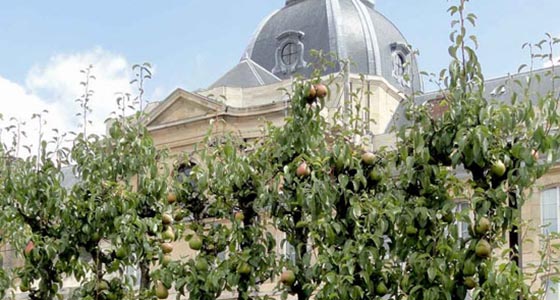
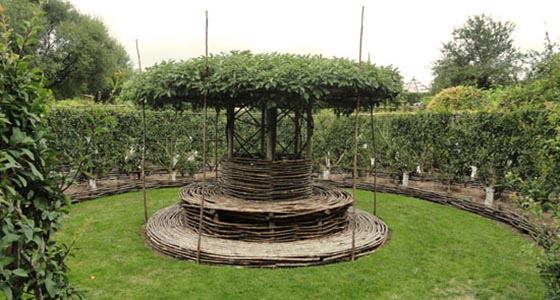
The gnarled old pear trees in full fruit were irresistable. Some were grown as espalier trees against the walls while others were trained on frameworks. I loved the double U forms grown as proud candelabres and the cordon with 5 double arms enclosing the vegetable gardens (see above). The special feature of this garden must be the pear tree formed into a large vase, with 16 leading branches arranged around the trunk (see below).

When the Jardins du Luxembourg in Paris were opened to the public in the 19th century, visitors could come and feast on fruit from the orchard for a small fee. These days, the orchard is situated in a small, enclosed corner of the garden and I could unfortunately only look through the fence at the more than 200 apples and pears beautifully trained into different shapes. Not far from the orchard was a collection of bee hives which I found very interesting, but what I enjoyed most was to see Parisians at play, with young and old having fun in the park on a Sunday afternoon.

Check in again tomorrow for more about Liesl’s trip through the gardens in France.

Comment

Prieure Notre Dame D’ Orsan – Part II

During July, our head gardener, Liesl van der Walt spent two weeks gardening at the Prieure Notre Dame D’ Orsan in France, which is the home of the architect Patrice Taravella, who designed the gardens at Babylonstoren. In Part II of her travel diary, Liesl tells us about tomatoes and bees:

I loved working in the vegetable garden with Estelle (above). First thing in the morning we picked whatever was ripe and needed by the restaurant. They have an exceptional good crop of tomatoes, beautifully trained onto different shaped wooden trellises.

Estelle’s main interest is beekeeping and it was fascinating to go with her to Orsan’s bee hives where she gave the small new swarms extra feeding during cold weather. She also showed me the traditional woven beehive she recently found on a market. These old hives, which are covered with mud to darken the inside, were used to as temporary hives when catching bees on the move.

I had a wonderful stay, learned so much, and hope to return again soon.

Groete,

Liesl


Comment

Elle Decoration, Netherlands, August 2011

Images from a trip to Babylonstoren in Dutch Elle Decoration.

Read full article here

Comment

At Prieure Notre Dame D’ Orsan – Part I

During July, our head gardener, Liesl van der Walt spent two weeks gardening at the Prieure Notre Dame D’ Orsan in France, which is the home of the architect Patrice Taravella, who designed the gardens at Babylonstoren. In Part I of her travel diary, Liesl shares what she learned about pruning.

At Orsan, Patrice has created a garden to compliment the old convent buildings that date from the Middle Ages. Patrice’s design very effectively captures the spirit of that time, when gardens had to feed the body, and also provide spiritual food and peace of mind for meditation. I especially went to learn from the head gardener, Gilles Guillot who has been part of the Orsan team for almost 20 years.  I wanted to discover how they maintain their beautiful creation.

As an introduction to the historical pruning techniques the French use to create different forms of fruit trees, Gilles got me practising on the climbing roses, with which he uses many of the same techniques. We pruned the old fashioned roses like Souvenir de la Malmaison and Mme. Alfred Carriere, both of which flower only once in spring. It was fascinating to train the roses back after cutting out the old wood, onto the different shaped structures that Gilles makes from chestnut wood.

After much practice, Gilles finally allowed me to work on his precious fruit trees, some that take 15-20 or more years to reach their final shape. We started with the summer prune which is done this time of the year mainly to control the fast growth.

Much to my surprise he continued stripping some of the apples and pears of their leaves to give me the experience of pruning in winter when the trees are dormant and the important cutting back is done to shape the trees and stimulate fruit.

More next week, about Liesl’s time in the vegetable garden.

1 Comment

Vogue, Japan, August 2011


         Read Full Article Here

Comment